
Botanical Extract
& Health Blog
Latest research, market trends, and sourcing guides for nutraceutical and botanical ingredients.
Explore Products
Nutraceutical
Knowledge Base
Expert articles on standardized extracts, functional mushrooms, and synthetic active ingredients.
View Certifications
Global Sourcing
& Market Trends
Stay updated with regional warehouse inventory, FDA compliance, and B2B market updates.
Learn MoreHow to Source Pure Moringa Leaf Extract in 2026?
Table of Contents
- Define Purity Specs Using HPLC Markers, Moisture, Ash, and Extract Ratios
- Verify Moringa Identity with DNA Barcoding and AOAC-Validated Methods
- Screen Heavy Metals, Pesticides, and Microbes Against USP and EU Limits
- Audit Suppliers Through ISO 22000, WHO GACP, COAs, and Batch Traceability
- Confirm Each Lot with Third-Party Testing and 25°C/60% RH Stability Data
- FAQS
- Conclusion
- Related Posts
Sourcing Pure Moringa Leaf Extract in 2026 requires more than comparing prices on supplier websites. Buyers must verify what “pure” actually means for each product. It may describe the plant source, extraction method, or absence of carriers. These meanings are not interchangeable. A reliable supplier should provide the botanical name, plant part, country of origin, and extraction details. Small details matter.
Start with a representative sample, not a sales promise. Examine its color, aroma, solubility, and powder texture. Then request a current certificate of analysis for the same batch. The report should cover active compounds, moisture, microbial limits, heavy metals, pesticides, and residual solvents. Independent laboratory testing adds confidence. It also exposes weak documentation. A certificate alone is not enough.
Experienced buyers should trace each batch from farm records to sealed cartons. Ask about harvest timing, drying temperatures, storage humidity, and packaging materials. Moringa leaves can lose quality when heat and moisture are poorly controlled. Supplier audits, video inspections, and reference checks can reveal practical weaknesses. Organic certification may help, but it does not automatically prove extract purity or potency. That assumption needs questioning.
In 2026, dependable sourcing will combine technical evidence with transparent communication. Suppliers should explain variability instead of hiding it. They should also provide corrective-action records when a batch fails specifications. A low price can become expensive after testing delays, rejected shipments, or reformulation. I would compare at least three qualified suppliers and retain sealed samples from every approved lot. Keep the evidence. Review it regularly. Pure Moringa Leaf Extract is not defined by appearance alone; it is supported by identity, testing, traceability, and consistent handling. Mistakes can still happen, so the sourcing process should leave room for rechecking.
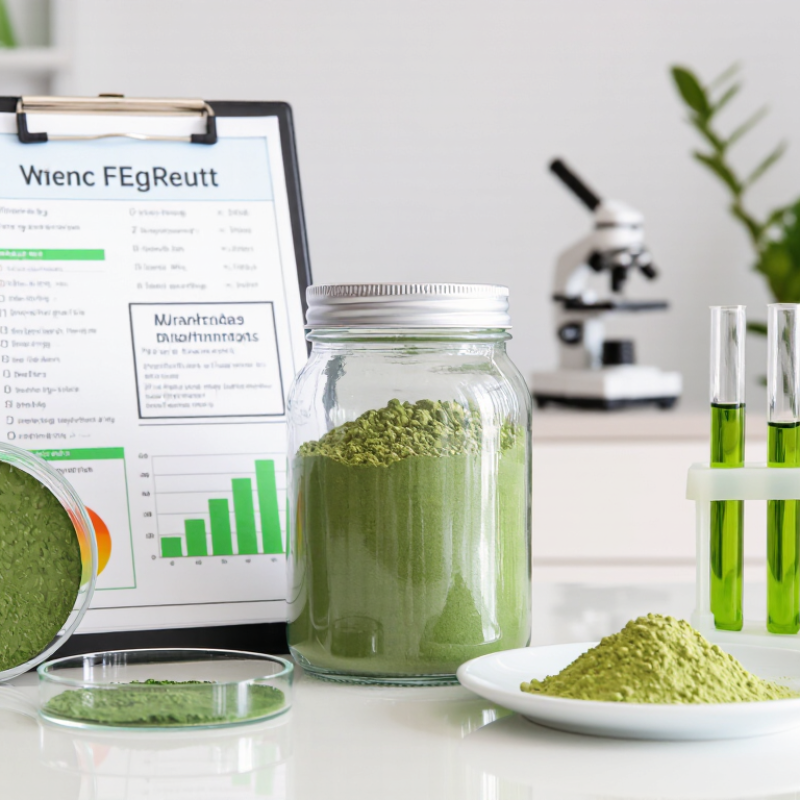
Define Purity Specs Using HPLC Markers, Moisture, Ash, and Extract Ratios
How to Source Pure Moringa Leaf Extract in 2026?
Purity begins with a written specification, not a supplier’s attractive certificate. Published compositional reviews report moisture commonly near 5–10% and ash around 8–12%, with strong variation by soil, drying, and harvest stage (Leone et al., 2015; Saini et al., 2016).
A practical starting point is moisture not above 8% and total ash not above 10%. Confirm both through validated AOAC methods, such as AOAC 925.10 and 942.05.
These limits need adjustment after real batch data.
Use HPLC to identify and quantify marker compounds, rather than relying on total polyphenols alone. Suitable markers may include:
Published HPLC studies show substantial differences between leaf origins and extraction conditions (Saini et al., 2016). Set a marker fingerprint, minimum assay range, retention-time match, and system-suitability criteria. One marker is rarely enough.
Extract ratios require careful interpretation. A claimed 4:1 ratio means four parts raw leaf produced one part extract; it does not prove stronger activity or cleaner material.
Request the plant part, solvent, yield calculation, and batch-specific HPLC results. Keep reserve samples. Inspect color, odor, and sediment, but do not treat appearance as evidence.
A clean-looking COA can still mislead.
My specification would remain provisional until three independent batches confirm it. Even then, geography may quietly change the chemistry.
Verify Moringa Identity with DNA Barcoding and AOAC-Validated Methods
How to Source Pure Moringa Leaf Extract in 2026?
Verify Moringa Identity with DNA Barcoding and AOAC-Validated Methods
A reliable sourcing process begins with plant identity, not a polished certificate. Ask suppliers for the botanical name, plant part, country of origin, harvest season, and authenticated reference material. DNA barcoding can compare genetic regions from a sample with verified Moringa oleifera references. It helps detect substitution with visually similar leaves. However, heavily processed extracts may contain little usable DNA. Testing the incoming leaf powder may provide stronger evidence than testing the final extract alone.
Purity needs more than one laboratory result. Request testing through an ISO/IEC 17025-accredited laboratory, when available. AOAC-validated methods can support measurements for selected nutrients, microbial hazards, moisture, or contaminants, depending on the matrix and method scope. Ask for the exact method number, reporting limits, sample preparation details, and laboratory date. A generic “passed” statement is weak evidence. Review chromatographic fingerprints or marker-compound results alongside the certificate of analysis.
Keep a retained sample from every batch. It supports investigations when color, aroma, or solubility changes unexpectedly. Packaging should show lot numbers and protect the extract from heat, light, and moisture. No test is perfect. DNA may fail, and an AOAC method may not cover every adulterant. I would document these gaps instead of treating a single certificate as proof. Supplier audits, chain-of-custody records, and periodic independent testing create a more defensible sourcing decision.
How to Source Pure Moringa Leaf Extract in 2026? – Verify Moringa Identity with DNA Barcoding and AOAC-Validated Methods
| Verification Dimension | What to Specify or Verify | Recommended Evidence | Release Consideration |
|---|---|---|---|
| Botanical identity | Moringa oleifera Lam.; plant part: leaf; material type: extract | Botanical specification, authenticated reference material, supplier batch records, and a certificate of analysis | Reject material identified only as “moringa” without species and plant-part confirmation. |
| DNA barcode identity | Use validated DNA barcoding appropriate for processed botanical material; commonly evaluated plant loci include rbcL, matK, ITS2, and trnH-psbA. | Independent laboratory report showing DNA extraction quality, target loci, sequence quality, reference database, similarity result, controls, and interpretation | A concordant species-level identification supports identity. DNA barcoding does not quantify extract purity, potency, or contaminant levels. |
| DNA test suitability | Recognize that heat, solvents, drying, and extraction can fragment or remove DNA. | Method suitability study or documented limitation for the exact extract matrix; positive and negative controls | A “no amplification” result should be treated as inconclusive unless the laboratory demonstrates that the method is suitable for the matrix. |
| Extract ratio and solvent | Declare the native-to-extract ratio, extraction solvent, extraction temperature range, and whether carriers or processing aids are present. | Manufacturing batch record, process flow, solvent declaration, and finished-product specification | Do not compare potency or price between extracts without normalizing the extract ratio and marker basis. |
| Marker compounds | Define measurable markers that are relevant to the product specification, such as total polyphenols or selected glucosinolates, rather than using “pure” as an analytical result. | Validated chromatographic or spectrophotometric method, reference standard information, calibration data, and result reported on a stated basis | Marker content confirms consistency of the tested attribute; it does not by itself prove botanical identity. |
| AOAC-validated analytical methods | Require AOAC Official Method status or another documented validation appropriate to the matrix and analyte for applicable tests. | Laboratory report stating the exact method reference, revision, matrix applicability, laboratory accreditation scope, and units | “AOAC tested” is insufficient without the exact method reference and result. Method suitability must match the extract matrix. |
| Microbiological quality | Set limits for total aerobic microbial count, total yeast and mold count, and specified pathogens according to the intended use and applicable regulations. | Recent microbiological certificate of analysis using applicable validated or compendial methods; sample quantity and lot number | Release only when results meet the agreed specification and the report identifies the tested production lot. |
| Heavy metals and elemental contaminants | Test lead, cadmium, arsenic, and mercury using a validated elemental-analysis method suitable for the product and intended market. | Method-specific report, limit of quantification, units, digestion procedure, recovery data, and comparison with applicable regulatory limits | A result reported only as “pass” is inadequate for risk assessment; numerical results and units should be supplied. |
| Pesticide residues | Use a multi-residue screen covering pesticides relevant to the cultivation region and destination-market requirements. | Laboratory report listing analytes, reporting limits, detected concentrations, recovery performance, and regulatory comparison | Confirm that the reporting limits are low enough for the destination market; “not detected” is meaningful only with a stated limit. |
| Adulteration and undeclared materials | Check for undeclared fillers, starches, sugars, synthetic colorants, non-moringa plant material, and unauthorized carriers where relevant. | Orthogonal testing plan combining microscopy, chromatography, DNA testing where suitable, and targeted adulterant assays | No single test detects every possible adulterant; use a risk-based combination of methods. |
| Moisture and physical quality | Set product-specific limits for loss on drying or water activity, appearance, color, odor, particle size, and dispersibility. | Finished-product specification, batch test results, packaging inspection, and storage-condition records | Limits should be established from stability and microbiological risk data rather than copied between different extract formats. |
| Traceability | Every sample and document should identify the same batch, production date, plant part, country or region of origin, and packaging unit. | Lot-specific certificate of analysis, chain-of-custody record, manufacturing date, expiry or retest date, and retained-sample policy | Do not accept a generic certificate that cannot be linked to the shipped lot. |
| Supplier qualification | Assess quality-system controls, change notification, deviation handling, complaint management, and corrective-action procedures. | Quality agreement, audit questionnaire, certificates within scope, change-control procedure, and documented corrective actions | Approve the supplier only after identity, contaminant, traceability, and process evidence are reviewed together. |
Screen Heavy Metals, Pesticides, and Microbes Against USP and EU Limits
How to Source Pure Moringa Leaf Extract in 2026?
A reliable sourcing process begins with the raw leaf, not a polished certificate. Ask for the botanical identity, country of cultivation, harvest date, extraction solvent, and full lot history. The supplier should provide a representative sample from the same production batch. A clean-looking powder proves very little.
Heavy metals need laboratory screening, preferably with ICP-MS or an equivalent validated method. Test lead, arsenic, cadmium, and mercury against the applicable USP requirements and current EU limits.
Do not accept vague wording such as “passes international standards.” Request numerical results, detection limits, test dates, and laboratory accreditation details. Soil conditions can change between fields.
Pesticide screening should cover likely agricultural residues, not only a short standard panel. LC-MS/MS and GC-MS/MS can detect different chemical groups.
Microbial testing should include total aerobic count, yeast and mold, and relevant pathogens such as Salmonella and E. coli. Water activity and moisture results also matter during storage.
A certificate of analysis is useful, but it is not independent proof. Verify selected lots through a qualified third-party laboratory. Sampling remains the weak point. Even a careful plan can miss uneven contamination. Keep sealed retain samples, review chain-of-custody records, and compare results with USP methods and EU food-safety requirements before approving the extract.
Audit Suppliers Through ISO 22000, WHO GACP, COAs, and Batch Traceability
How to Source Pure Moringa Leaf Extract in 2026?
Supplier qualification should begin with evidence, not polished brochures. The ISO Survey 2022 recorded more than 57,000 ISO 22000 certificates worldwide. Certification still requires verification. Ask for the current certificate, scope, audit date, and manufacturing site. Confirm that the scope covers botanical extraction, not only storage or trading. Review HACCP plans, sanitation controls, allergen management, and product recall tests. WHO GACP guidance also expects documented cultivation, harvesting, drying, and contamination controls. A certificate alone is not proof.
A reliable COA should identify Moringa oleifera, the plant part, extraction ratio, solvent, and batch number. It should report moisture, microbial counts, heavy metals, pesticide residues, aflatoxins, and residual solvents. Check test methods, detection limits, laboratory qualifications, and sampling dates. “Pure” needs a measurable definition. A high marker level does not automatically prove authenticity. That mistake is common.
Traceability should work backward from the finished drum. Request farm or collection location, harvest date, drying temperature, processing records, packaging details, and retained-sample procedures. Compare the COA number with labels and production logs. The WHO Global Report on Traditional and Complementary Medicine 2019 found that 88% of WHO Member States reported using traditional medicine, increasing pressure on supply chains. Independent testing remains sensible, especially after a supplier change. I would also document weaknesses openly. Missing pesticide records may reflect poor control—or simply poor filing. Either way, it needs correction before approval.
Confirm Each Lot with Third-Party Testing and 25°C/60% RH Stability Data
Sourcing pure moringa leaf extract in 2026 requires evidence beyond a polished certificate. Request a retained sample, botanical identity testing, and a lot-specific certificate of analysis. Third-party laboratories should confirm marker compounds, moisture, microbial counts, pesticides, heavy metals, and undeclared fillers. HPTLC or HPLC can verify the plant profile. DNA testing may support identity, but it cannot prove extract strength alone. That distinction matters.
Stability evidence should match the actual packaging and extract ratio. ICH Q1A(R2) identifies 25°C/60% RH as a long-term condition for many controlled products, while 40°C/75% RH supports accelerated evaluation. Ask for real-time data, not only projections. WHO Technical Report Series guidance on herbal medicines also emphasizes identity, contaminants, and batch consistency. Review at least three lots, checking marker retention, color, odor, water activity, and microbial trends at each time point. A single passing test is weak evidence.
Inspect the raw data. Ask for laboratory accreditation, methods, detection limits, chromatograms, and chain-of-custody records. The USP Food Fraud Database shows why botanical supply chains need authenticity controls, although it does not replace product-specific testing. Some suppliers provide beautiful reports with missing sampling details. That should slow the purchase. Pure is not a conclusion; it is a documented, repeatable result.
FAQS
Request botanical identity, cultivation country, harvest date, solvent, extraction ratio, and complete lot history. Ask for a sample from the same production batch. A clean powder means little.
Test lead, arsenic, cadmium, and mercury using ICP-MS or an equivalent validated method. Request numerical results, detection limits, test dates, and laboratory accreditation details. Soil conditions vary between fields.
Use broad pesticide screening rather than a short standard panel. LC-MS/MS and GC-MS/MS detect different chemical groups. Missing records should delay approval.
Request total aerobic count, yeast and mold, Salmonella, and E. coli results. Also review moisture and water activity data. A damp powder can deteriorate during storage.
Check the batch number, plant part, extraction ratio, solvent, methods, and sampling date. Review detection limits and laboratory qualifications. A certificate is useful, not independent proof.
Request current food-safety certification, audit scope, audit date, and manufacturing-site details. Confirm the scope covers botanical extraction, not only storage or trading. Review sanitation, allergen controls, recall tests, and hazard plans.
Trace each finished drum to its farm or collection location. Review harvest dates, drying temperatures, processing logs, packaging details, and retained samples. Compare labels with production records. Small filing errors can hide larger weaknesses.
Independent testing is sensible, especially after a supplier change or unusual result. Test identity, marker compounds, moisture, microbes, pesticides, metals, and undeclared fillers. DNA can support identity, but it cannot prove extract strength.
Ask for real-time data at 25°C and 60% relative humidity when appropriate. Accelerated testing may use 40°C and 75% relative humidity. Review at least three lots for color, odor, moisture, water activity, markers, and microbial trends. One passing test is weak evidence.
Conclusion
Sourcing Pure Moringa Leaf Extract in 2026 requires a structured, evidence-based quality process. Buyers should first establish clear specifications for key HPLC markers, moisture, ash, and extract ratios to ensure consistent identity and potency. Botanical authenticity can then be confirmed through DNA barcoding and validated analytical methods, while testing for heavy metals, pesticide residues, and microbial contamination should meet applicable USP and EU safety limits.
Supplier qualification is equally important. Reliable partners should demonstrate strong food-safety systems, responsible agricultural practices, complete certificates of analysis, and transparent batch traceability. Every production lot should undergo independent third-party testing before approval. In addition, stability data collected at 25°C and 60% relative humidity can help verify shelf life, packaging suitability, and product performance under controlled conditions. By combining defined specifications, authenticated raw materials, comprehensive safety screening, supplier audits, and lot-level verification, buyers can reduce quality risks and confidently select a consistent Pure Moringa Leaf Extract for their intended application.

Blog Tags: